My Apple Playlists, My iPod and the music behind The Song of the Midnight Rider

Lex E. Santí,
My old iPod is sitting on my desk again, or at least it will be when the charger arrives. I ordered it on eBay without thinking too hard about why, the way you sometimes reach for something instinctively, like calling an old number you’re not sure still works. I know the playlists are still on it. A while back, I hacked the battery and upgraded it. I even tried to buy a mod for a Bluetooth plugin and then gave up. I'm looking forward to having it in my life again.
The New York Times recently wrote about how iPods are quietly coming back, not as nostalgia pieces exactly, but because they do less. They interrupt less. They don’t ask anything of you except to listen. And I realized, reading that, that what I missed wasn’t just the object, it was the condition it created—the sense that music had a center, and that I could locate myself inside it.
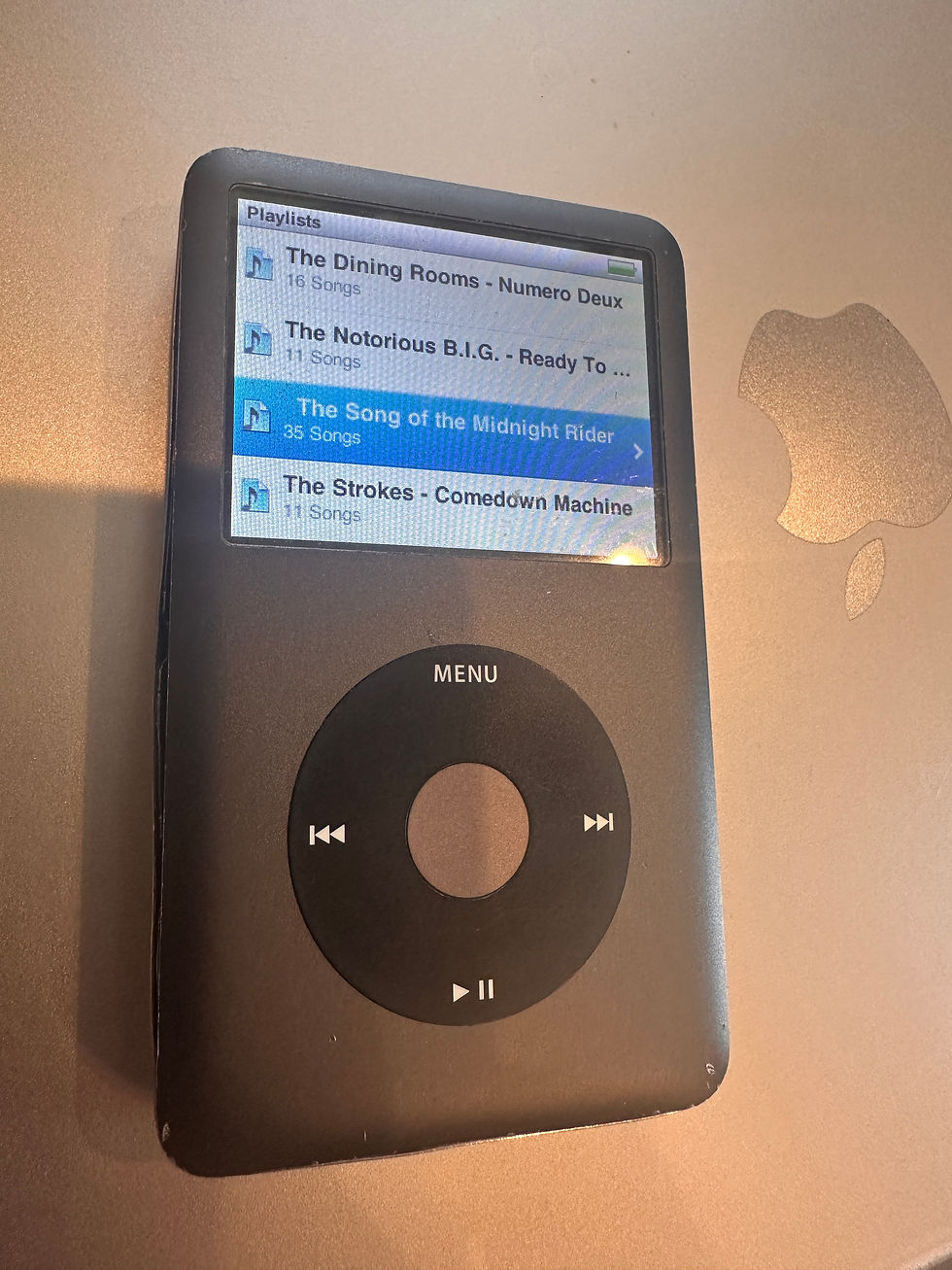
There used to be a joke, or maybe it wasn’t a joke so much as a wish people said out loud: we don’t want a phone that plays music, we want an iPod that makes phone calls. At the time it sounded like a throwaway line, but it turns out to be a kind of thesis about what came next. Because the difference between those two things is whether music is central or peripheral, whether a device is organized around listening or where listening has to fight for space with everything else. Somewhere along the way, music stopped being the axis and became just another app, another tab, another stream in a life that is constantly asking to be refreshed.
Music has always lived with me in a way that is difficult to explain now without sounding sentimental, but it wasn’t sentimentality—it was structure. I built playlists slowly, deliberately, sometimes over weeks, moving tracks up and down until something clicked, until the sequence felt inevitable. I burned CDs for friends and for people I was falling in love with, or trying to fall out of love with, or trying to say something to that I couldn’t quite say directly. A playlist was a message. And before playlists and CDs, I dubbed tapes on a dual-track tape deck and copied albums, passing them around and giving or receiving them from Hyun Kim as a way of saying, "Hey, I say you." It was a confession, or an offering, or sometimes just a way of saying: this is how I hear the world right now, do you hear it this way too? And when someone listened, really listened, there was a kind of recognition that passed between you that had nothing to do with efficiency or convenience. It took time. It required attention. It meant something because it could end.

I wrote to those playlists and traded music with Colin Thornhill reverently in graduate school. I built parts of The Song of the Midnight Rider inside them, long before I had the language for what the book was becoming. Certain songs didn’t just accompany scenes—they revealed them. They told me who Jordan Samson was before I could articulate it in prose. The playlists were not background; they were scaffolding, architecture, a kind of parallel text running alongside the writing itself. Gregg Allman's version of Song of the Midnight Rider, still gives me chills.
Please give me a moment to rant about my favorite company though, because I believe Apple understood all that once about music once. Or at least it felt like they did. I mean, Steve Jobs was a music obsessive, and he dated musicians, right?! His biography tells you as much. They gave us the tools and then got out of the way. They let the library be ours. The iPod didn’t interrupt. It didn’t suggest. It didn’t optimize. It held what you gave it and played it back faithfully. There was something almost sacred about that relationship, even if we didn’t call it that at the time.
I remember when that started to change, and I don’t think it was one moment so much as a slow erosion, but there was a point where syncing stopped feeling like magic and started feeling like negotiation. Hours watching a progress bar crawl across a screen while my phone tried to reconcile itself with my library, as if the two no longer recognized each other. Songs duplicated, or disappeared, or reappeared with the wrong metadata, the wrong artwork, the wrong version. It was subtle at first, then less so, and eventually it felt like the system no longer trusted me as the source of truth. Music, which had once felt stable and personal, became something I had to manage, to monitor, to fix.
At the same time, the devices themselves were changing. Phones got thinner, sleeker, more powerful, and somehow less able to hold the thing that mattered most to me. Storage became scarce in a way that felt designed, not accidental. My relationship with my own music turned into a series of choices I didn’t remember agreeing to: pay for more iCloud storage, start carrying external drives, or begin letting go of parts of the library I had spent years building. I chose not to let go. I bought the drives. I still have them. They sit in drawers and bags, small, dense containers of a past I refused to abandon, even as the systems around me kept insisting that I should.
What Apple called the cloud was supposed to be seamless, invisible, effortless. But for me, it always felt like a displacement, a quiet shift of authority away from me and toward something I couldn’t see or control. My library no longer lived somewhere I could point to. It lived somewhere abstract, conditional, subject to syncing, matching, updating, and reconciling. Words that don’t belong anywhere near something as intimate as a music collection.
What frustrates me is that Apple didn’t lack the raw material to get this right. The playlists were already there. The libraries were already there. People had been curating for years, building these deeply personal systems of meaning inside iTunes and on their iPods. Apple didn’t invent that impulse, but it honored it, amplified it, and made it feel legitimate. And then, when streaming arrived, instead of extending that relationship, they fractured it. iTunes remained one thing, Apple Music became another, and somewhere in that split my musical past stopped being connected to my musical future.
I keep coming back to the sense that something simple could have been said and wasn’t: we see what you built, and we’re going to carry it forward with you. Instead, what arrived was a parallel universe. Ownership over here, access over there. Files versus streams. The playlists I had made didn’t evolve; they stalled. They stayed behind, and I moved on, or was moved on, into a system that no longer recognized them in the same way.
And so now I pay Spotify every month, and I don’t like it. Not because Spotify is doing anything wrong, but because it solved a problem that didn’t need to exist in the first place. It removed the friction, the management, the constant low-level anxiety about whether my library was intact or corrupted or somewhere in between. It gave me continuity, even if it came at the cost of ownership. It made my listening history portable, stable, and always available. It didn’t ask me to maintain anything. It didn’t ask me to grieve.
But there’s a cost to that ease that I feel more and more as time goes on. The playlists are endless now. They don’t end, and because they don’t end, they don’t hold the same weight. They expand, they refresh, they update themselves. Discovery is constant, which means it’s also diffuse. Where does anything begin? Where does anything land? I find myself listening to things on SoundCloud, or through auto-generated mixes, and thinking, almost jokingly but not really: hark, who goes there? What am I hearing, and where did it come from, and why does it feel like it could just as easily be replaced by something else in the next second?
The old playlists didn’t do that. They had edges. They had an intention. They stopped.
The iPod, when I finally power it back on, will still retain that listening mode. Finite, deliberate, arranged. It won’t interrupt me. It won’t ask me to check anything else. It won’t try to improve what I chose. It will just play it, the way I left it.
The Song of the Midnight Rider has a playlist because it always did. The music has been inside that book for twenty years, moving with it, shaping it, waiting for it to catch up. I’ve put that playlist on Spotify now, because that’s where we are, because if I want to share it, that’s the language the world understands.
But part of me still believes in the older model, the one where the playlist itself was the artifact, where it meant something because someone made it and then let it be finished. Where music wasn’t just an infinite stream but a shaped experience, something you could hand to another person and say: this is it, this is the thing, listen from the beginning.
They can move everything else to the cloud.
I’m not sure they ever understood what they were asking us to leave behind.


Comments